


The academic landscape has shifted tectonic plates over the last few years. In 2026, the question isn’t whether you should use AI in your studies, but how effectively you are leveraging it. With the global AI in education market projected to surpass $32 billion by 2030, according to recent Global Market Insights, students today are navigating a “Phygital” (Physical + Digital) learning environment that demands efficiency, precision, and critical thinking.
The “homework grind” of late-night coffee and manual research is being replaced by streamlined, AI-integrated workflows. However, the secret to staying ahead isn’t just letting a bot do the work; it’s about using these tools as intellectual force multipliers. By automating repetitive tasks like formatting, initial drafting, and data organization, you free up your cognitive load for what actually matters: deep learning and application.
Managing a heavy course load in 2026 requires a strategic balance between self-study and professional support. While AI tools are incredible for organization, there are moments when the sheer volume of tasks becomes overwhelming. In such cases, many students find it beneficial to do my homework through professional academic services that offer human-led expertise to complement digital tools. This hybrid approach ensures that while your routine is tech-driven, your grades remain backed by subject-matter mastery.
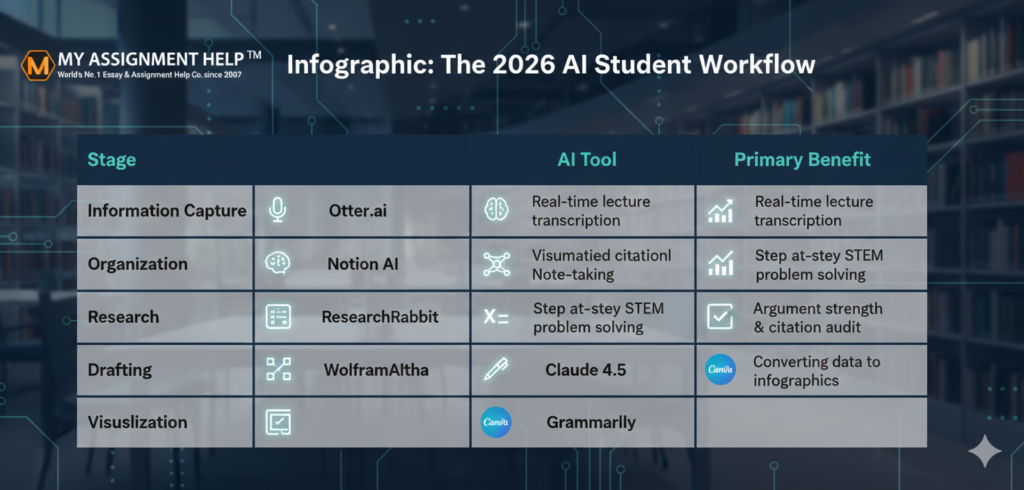
Here are the top 7 AI-powered tools that are currently redefining homework efficiency in 2026.
1. Claude 4.5: The Context King
By 2026, Claude has emerged as the preferred tool for humanities and social science students. Unlike its predecessors, Claude 4.5 offers a massive 500k token context window, allowing you to upload entire textbooks or a semester’s worth of lecture notes to find specific correlations. It excels in nuance and tone, making it perfect for brainstorming essay outlines that sound human and logical rather than robotic.
2. WolframAlpha (AI-Integrated Edition)
WolframAlpha has evolved beyond a simple computational engine. Its 2026 AI-integrated version uses natural language processing to explain complex thermodynamic or calculus problems step-by-step. According to a 2025 study by the National Center for Education Statistics, students using step-by-step computational AI saw a 22% improvement in STEM-related test scores compared to those using traditional textbooks.
3. Grammarly Business & Academic Suite
Grammarly in 2026 doesn’t just fix commas; it analyzes the “strength of argument.” It uses predictive AI to suggest where you need more evidence or where your logic might be circular. It also includes an integrated “Source Verifier” that checks your citations against real-time databases to ensure no “AI hallucinations” have crept into your bibliography.
4. Notion AI: The Second Brain
Notion has become the central hub for the modern student. Its AI features now include “Automatic Synthesis,” which takes your scattered voice notes from a lecture and turns them into formatted Cornell notes. It also syncs with your calendar to predict which assignments will take the most time based on your past performance data.
5. ResearchRabbit
ResearchRabbit is the “Spotify of academic papers.” In 2026, its AI mapping technology allows students to visualize the relationship between different peer-reviewed articles. When you find one relevant paper, ResearchRabbit’s AI “follows” the citations and authors to create a visual map of the entire field of study, drastically reducing the time spent on literature reviews.
6. Canva Magic Studio
For students in design, marketing, or even biology, presentation matters. Canva’s 2026 Magic Studio allows you to turn a text-based essay into a fully designed, 10-slide presentation or an infographic in seconds. This allows students to focus on the data while the AI handles the visual hierarchy and aesthetic consistency.
7. Otter.ai: The Ultimate Auditor
Otter.ai’s latest iteration provides real-time transcription with a twist. It now features an “Ask the Lecture” bot. If you missed a point during a 2-hour seminar, you can simply type, “What did the professor say about the Treaty of Versailles?” and it will play back that specific segment and provide a summarized transcript.
I
Navigating the Ethics of AI in 2026
While these tools are revolutionary, the academic world in 2026 has strict guardrails. Institutions now use “AI-Process Tracking” rather than just “AI-Detection.” This means professors look at the history of your document to see if it evolved naturally or was copy-pasted in one go.
If you find yourself stuck behind a wall of complex requirements that AI cannot solve—such as original laboratory analysis or highly specific case studies—it might be time to pay someone to do my homework who is a verified human expert. This ensures that your work maintains the “Human Intelligence” (HI) factor that top-tier universities still prioritize over 100% machine-generated content.
Key Takeaways
- Efficiency over Automation: Use AI to handle the “drudge work” (formatting, summarizing) so you can focus on critical analysis.
- Verify Everything: AI hallucinations still exist in 2026; always use tools like WolframAlpha or Grammarly to double-check facts.
- The Hybrid Model: Combine AI tools for daily routines with professional human services for high-stakes assignments.
- Visual Learning: Leverage tools like Canva to turn complex data into visual formats, which aids in long-term retention.
FAQ Section
Q1: Will using AI tools count as plagiarism in 2026?
It depends on the usage. Using AI for brainstorming or organizing is generally accepted. However, submitting raw AI output as your own is considered “Contract Cheating.” Always use AI as a co-pilot, not the pilot.
Q2: Are there any free AI tools left for students?
Yes, most tools like Claude and Notion offer “Academic Tiers” which are free or heavily discounted for users with a valid .edu email address.
Q3: How do I know if an AI tool is giving me fake references?
Always cross-reference AI-generated citations with Google Scholar or the ResearchRabbit tool mentioned above. If the DOI (Digital Object Identifier) doesn’t lead to a real paper, the reference is a hallucination.
Q4: Can AI help with math and physics?
Absolutely. WolframAlpha remains the gold standard for computational accuracy, as it uses a symbolic engine rather than just a language model.
Author Bio
Dr. Sarah Jenkins is a Senior Academic Consultant at MyAssignmentHelp. With over 12 years of experience in Educational Technology (EdTech) and a PhD in Curriculum Development, Sarah specializes in helping students integrate AI tools into their study routines ethically and effectively. She has been a guest speaker at the Global Education Summit and frequently contributes to journals on the evolution of digital pedagogy.
References:
- Global Market Insights (2025): “AI in Education Market Size and Forecast.”
- National Center for Education Statistics (2025): “The Impact of Computational AI on STEM Learning Outcomes.”
- Journal of Academic Integrity (2026): “The Shift from Detection to Process-Based Evaluation.
